
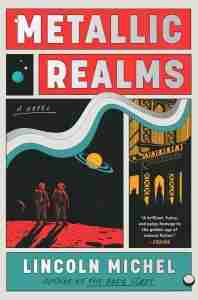
 Early on, Lincoln Michel’s Metallic Realms (2025) threatens to be one of those by-writers, for-writers books that oversteps into recursive indulgence. Well…in retrospect, it may still be that, while also managing to transcend it. A tragically funny meditation on creative friendship in our anxiety-ridden anthropocene times, this metafictional novel is written from the point of view of one Michael Lincoln, a deep-nerd science-fiction reader and the self-professed “scholar” chronicling the creative output of an SF writing group known as the Orb 4. Michael orbits this group thanks to his childhood friendship with its founder, Taras K. Castle, who puts up with his peculiar ways, despite his awkward effect on the group dynamic. Michael’s purple career history of the Orb 4 — which also consists of Taras’s cosplaying girlfriend Darya Azali, their MFA lit-writer friend Jane Noh Johnson, and nonbinary creative free spirit S.O.S. Merlin — dives deep into their collective, co-written short-fiction sequence The Star Rot Chronicles. Michael’s reverance for the output of this creative cohort drives him to extreme lengths to promote the work…and to shoehorn himself into the equation. But Michael isn’t exactly a reliable critic, nor is he remotely self aware, his adoration for the group a reflection of his deeper psychological issues.
Anyone who has spent a fair amount of time as part of the speculative writing community has met That Science Fiction Guy. It seems clear that Michel has, and he captures him brilliantly in Metallic Realms, articulating his point of view with a mix of humorous derision and, more crucially, implicit empathy. “Michael Lincoln” is the classic outsider looking in, his social ineptitude drawing him to the niche realms of speculative fiction — with all its Slan-nish exceptionalism. His voice, annoying as it is, grows increasingly compelling as the story progresses, especially as we get to learn more about the Orb 4 and begin sampling their work. The Star Rot Chronicles Michael loves so dearly won’t be unfamiliar to anyone who has read an average SF slushpile: not without promise, but certainly not earth-shattering. But Michael’s hero worship of Taras and his friends murks up his judgement, blowing the importance of the group’s work way out of proportion. As such, the story he’s telling is unconvincing. But the one Michel is telling — about the joys and perils of creative friendship, particularly in a time characterized by existential dread and devaluing attitudes toward artistic output — is surprisingly powerful. The metafictional angle gives Metallic Realms an unusual “non-SF” vibe; it’s not science fiction, but it is about SF so intrinsically that it has a certain thought-provoking speculative energy. I would be very curious to hear how non-insiders respond to this book. But as someone who has experienced crit-group dynamics and the dreams and frustrations of the publishing business, it spoke to me — if not through Michael’s unreliable narration, then through its cagey subtexts.